China Energy Watch
Before They Came to Hamburg
More than 110 Chinese companies are expected at WindEnergy Hamburg this year. Their growing international presence is hard to miss. Less visible is the industrial ecosystem behind it, built over two decades of domestic scale, regional clustering, global supply chain participation and intense competition.
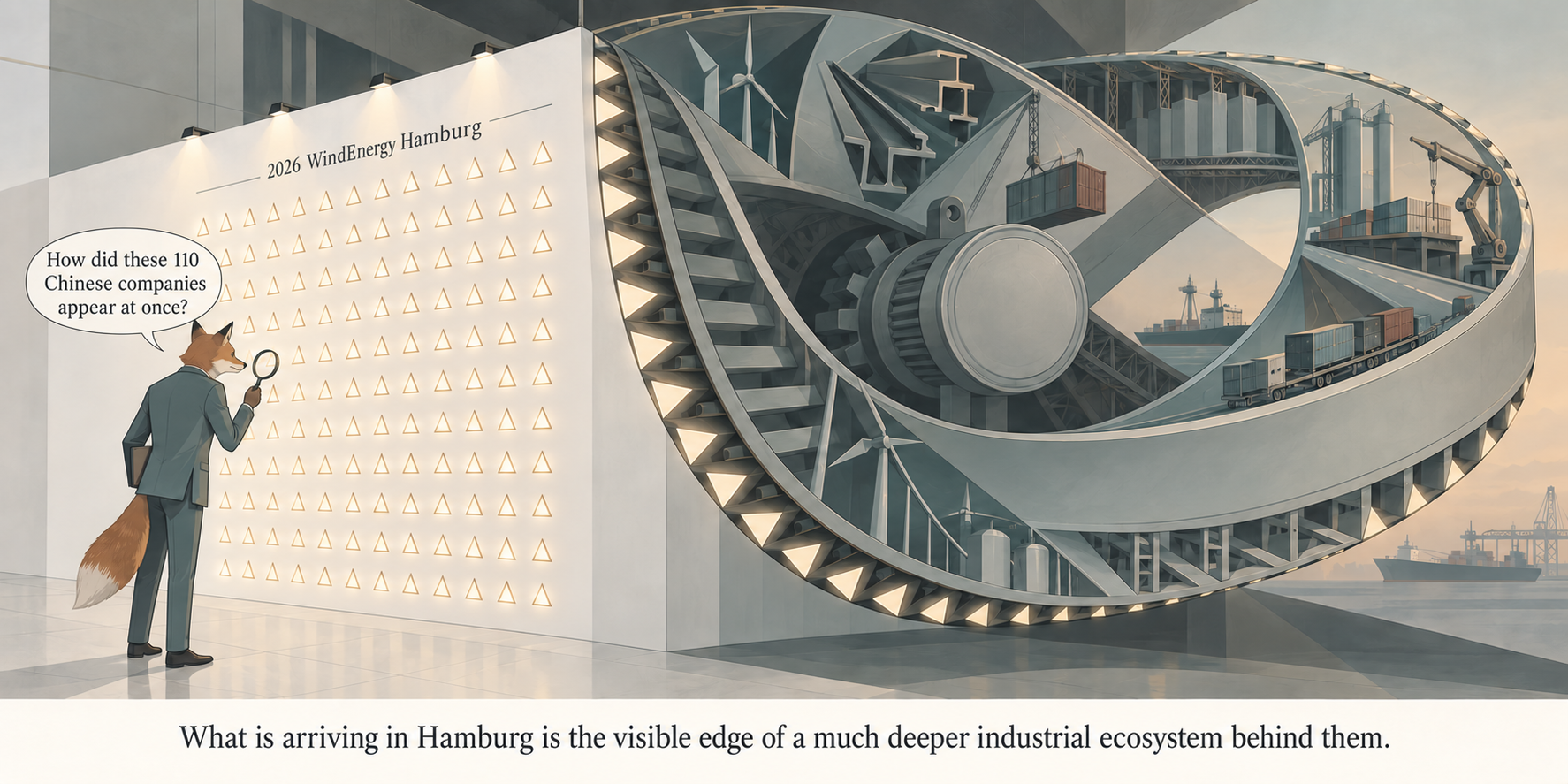
When WindEnergy Hamburg opens next week, more than 110 Chinese companies are expected to exhibit. That compares with more than 90 in 2024, 42 in 2018, 25 in 2016 and 17 in 2014.
The obvious interpretation is globalization. But that explains where these companies are going, not where they came from.
To understand that, it is worth looking at a Chinese city most European wind professionals have probably never heard of.
Fifteen years in one Chinese city
Yancheng sits on the coast of Jiangsu province, roughly 300 kilometers north of Shanghai. It is a prefecture-level city with around 6.6 million people.
Its 582-kilometer coastline faces the Yellow Sea, where average annual wind speeds at 100 meters exceed 7.6 m/s nearshore and approach 8 m/s farther offshore.
Wind development in Yancheng began around 2005, and manufacturing followed quickly. By 2010, Yancheng was already home to 25 major wind equipment manufacturers, including companies such as Sinovel, Goldwind and Shanghai Electric.
Five years is not long for an industrial base to take shape. The speed also brought disorder, prompting the municipal government to intervene more systematically.
In 2010, the city introduced a plan intended to bring greater structure to what was already emerging. Different parts of Yancheng would develop around manufacturing bases anchored by companies including Sinovel, Goldwind, Dongfang Electric and Shanghai Electric, covering turbines and key components such as blades, towers, flanges and subsea cables.
How the cluster grew
The plan alone did not build the cluster. Wind projects created demand for equipment, anchor manufacturers attracted suppliers, and a denser supply chain made the location more useful to the next company. In Dafeng district, for example, Goldwind was followed by manufacturers including CRRC Electric and blade suppliers. By 2023, the Dafeng wind industrial park alone had more than 30 wind companies.
Today, the wider Yancheng ecosystem includes turbine manufacturing by Goldwind, Envision Energy and Shanghai Electric, blades from Sinoma, offshore foundations from Haili Wind Power, and subsea cables from ZTT.
Government planning evolved with the industry. A 2024 plan mapped the offshore wind supply chain almost component by component: resins, structural adhesives, glass and carbon fiber, coatings, blades, generators, bearings, gearboxes, control systems, turbines, installation and O&M. It identified gaps in the chain, companies the city wanted to attract or work with, and even which districts and counties should engage them.
The evolution of these documents tells its own story. In 2010, Yancheng was organizing an emerging industry around turbines, blades, towers and flanges. By 2024, its industrial map reached into materials, components, controls and services.
The evolution was not linear, and the companies at the center of it did not necessarily remain the same. Sinovel, one of the anchor manufacturers in the 2010 plan and then one of the world's largest turbine makers, subsequently lost that position.
The individual companies changed. The industrial direction endured.
Scale then did something policy alone could not: it created repetition.
Successive generations of turbines meant successive generations of blades, bearings, castings, forgings, converters, foundations and cables. Processes were repeated and refined, while specialized suppliers accumulated experience.
Over time, the advantages became cumulative. Resource, market demand, corporate investment, industrial clustering and local planning reinforced one another. What had started with wind farms had become an industrial system.
A supply chain Europe already knew
For European OEMs, however, much of this development was not taking place entirely out of sight.
Vestas, Siemens Gamesa, GE and others have sourced components from China for many years. In qualifying and integrating Chinese suppliers into their global supply chains, their technical and quality requirements also became part of the environment in which these suppliers developed.
Domestic scale provided repetition and industrial depth, while international customers added another layer of technical and quality requirements.
That history should not be confused with consistent execution. Having the technical capability and a formal quality system does not necessarily mean that the system is applied consistently on the shop floor. This is a due diligence issue we explore separately in this issue.
The broader point is that many of the suppliers now becoming more visible in Europe had already spent years working inside global supply chains.
Aeolon is one example. It was supplying Western OEMs years before today's debate about Chinese wind companies entering Europe. Its blades internationalized before the company itself did. It has since established engineering capability in Germany and manufacturing in Morocco.
From supplying the world to entering it
The same industrial system that created scale and capability also created intense competition.
SANY Renewable Energy sold 6.29 GW of turbines in the first half of 2026, 5.79 GW of it in China, while its overall turbine gross margin was just 5.31%.
The reasons for going overseas vary. Some are following customers they have supplied for years. Some are looking for growth beyond a fiercely competitive domestic market. Others are turning manufacturing capabilities built in China into international businesses.
Chinese products have been part of international wind supply chains for years. Increasingly, the companies behind those products are becoming international actors themselves.
Hamburg makes that transition unusually visible. What Europe is encountering is not a Chinese wind supply chain that suddenly appeared at its doorstep. The 110-plus exhibitors are the product of an industrial base that has been developing for two decades, first through China's domestic wind market and increasingly through global supply chains.
What is arriving in Hamburg is not simply a larger group of Chinese companies. It is the visible edge of a much deeper industrial ecosystem behind them.
About Nuancia
Nuancia offers a closer view of Chinese companies across international energy projects and supply chains, Chinese business culture, and the practical realities of working with Chinese companies.
Nuancia is published for general information and commentary only. It does not constitute legal, financial, investment, engineering or other professional advice. Views and interpretations are those of the author unless otherwise stated. Full disclaimer