China in Context
What Sits Behind “Yes”
Behind the familiar “no problem, we can change it” can sit very different levels of experience, capability and confidence. Understanding the difference matters.
It often happens early in the relationship.
A Chinese company is meeting a potential international customer, hoping to enter a new market or win a contract. The customer explains that its requirements are different: a specification needs changing, a component needs redesigning, or something needs to be done in a way the supplier has not done before.
The response often comes quickly: “No problem. We can change it.”
There is an obvious commercial reason for this. The company wants the opportunity. Yet the answer is also shaped by a business environment in which speed, responsiveness and the ability to adjust have long been rewarded.
For a customer, however, the important question is what that particular “yes” is based on.
Speed as a business instinct
There is a line widely known from Chinese martial arts fiction: “天下武功,唯快不破” No martial art is unbeatable, except speed.
In the early years of China's economic reforms, another phrase became famous: “時間就是金錢,效率就是生命” Time is money; efficiency is life. First displayed in Shenzhen's Shekou Industrial Zone, it captured something fundamental about the economic transformation taking place.
Many of the entrepreneurs and managers who built modern Chinese companies grew up when resources were still scarce, then spent their careers in an economy expanding at extraordinary speed. Opportunities appeared quickly, competitors followed just as quickly, and waiting could mean losing the opportunity altogether.
The experience of scarcity, followed by decades in which speed could determine who captured the next opportunity, left a strong generational and institutional memory. Efficiency was rewarded, but so were decisiveness, experimentation and the willingness to act before every question had been answered.
Speed needs an ecosystem
There is another feature of China's manufacturing economy behind this speed. When a commercial opportunity proves itself, competitors tend to follow quickly and in large numbers. Not all survive. Some become industry leaders; others find their place at different price points or in more specialized parts of the market. The result is not simply more competition, but dense industrial clusters with unusual depth and range.
Around the leading manufacturers grow component suppliers, specialist workshops, tooling and equipment providers, together with large pools of engineers and skilled technical workers. Years of competition within these clusters continually push companies on cost, quality, capability and speed. For customers, this creates a supply base that can span very different levels of technical and manufacturing sophistication.
That density becomes particularly valuable when something needs to change. A different material, revised tooling, another component or a new prototype may involve several companies and specialist capabilities. When they sit within the same industrial cluster, each iteration can happen with much shorter handovers.
Shenzhen provides an unusually visible example. Known for its electronics manufacturing clusters and its role in global supply chains, the city brings an extraordinary range of capabilities into close proximity. In a WIRED documentary on its hardware ecosystem, one engineering team estimated that specialist work taking around a month in the UK could be completed in a couple of days in Shenzhen. Standard parts ordered in the morning could sometimes arrive that afternoon or the next day.
In wind, of course, speed is only part of the equation. A new or modified solution may still require relevant manufacturing experience, engineering verification, qualification, testing and certification. Industrial density does not remove those requirements, but it can affect how quickly the work around them moves.
China does not necessarily eliminate the steps. It compresses the distance between them.
What does “yes” actually mean?
This is where the early story of Finework becomes useful.
Finework started as a small machining workshop, actively seeking out new business and building capability as opportunities emerged. “There was nothing we couldn't make, only something the customer hadn't designed yet” became an early motto.
As Finework moved into wind, that willingness to take on new requirements was gradually backed by specialized manufacturing capability. Today, its global share of wind blade inserts and bushings is around 70%.
Finework illustrates how willingness to take on a new requirement can, over time, develop into established manufacturing capability.
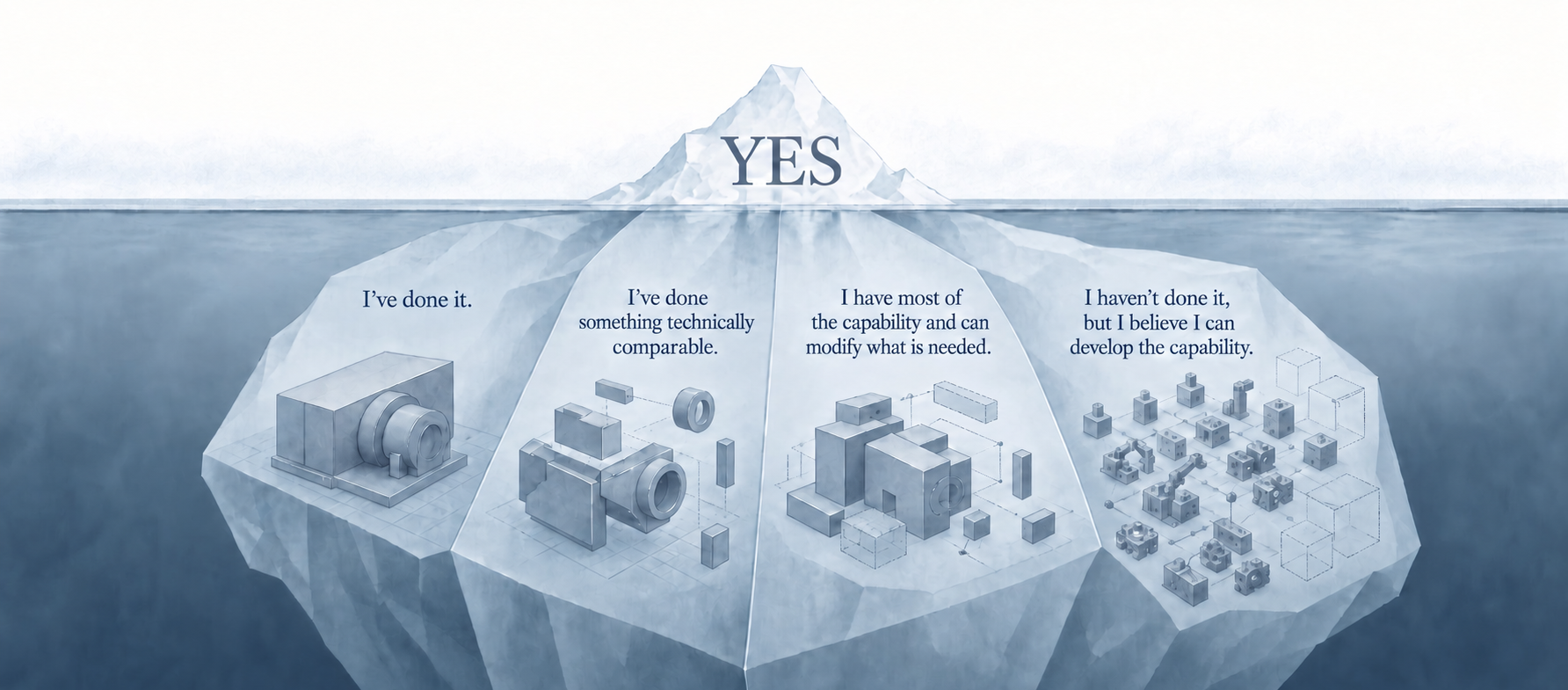
That brings us back to the “yes” across the table. The same answer can mean very different things:
I've done it.
I've done something technically comparable.
I have most of the capability and can modify what is needed.
I haven't done it, but I believe I can develop the capability.
For the customer, these are not the same proposition.
The industrial environment described above helps explain why a company may be confident about taking on something it has not done before. It does not tell the customer whether that confidence is justified. That is something the company still needs to demonstrate.
So “yes, we can change it” is not the end of the question. What matters is knowing how to interpret that yes, and what to look for behind it.
About Nuancia
Nuancia offers a closer view of Chinese companies across international energy projects and supply chains, Chinese business culture, and the practical realities of working with Chinese companies.
Nuancia is published for general information and commentary only. It does not constitute legal, financial, investment, engineering or other professional advice. Views and interpretations are those of the author unless otherwise stated. Full disclaimer