China in Context
When Business Moves to WeChat
WeChat occupies an unusual space in Chinese business, where professional communication and personal connection overlap. Understanding that space can make communication easier and help relationships develop beyond formal exchanges.
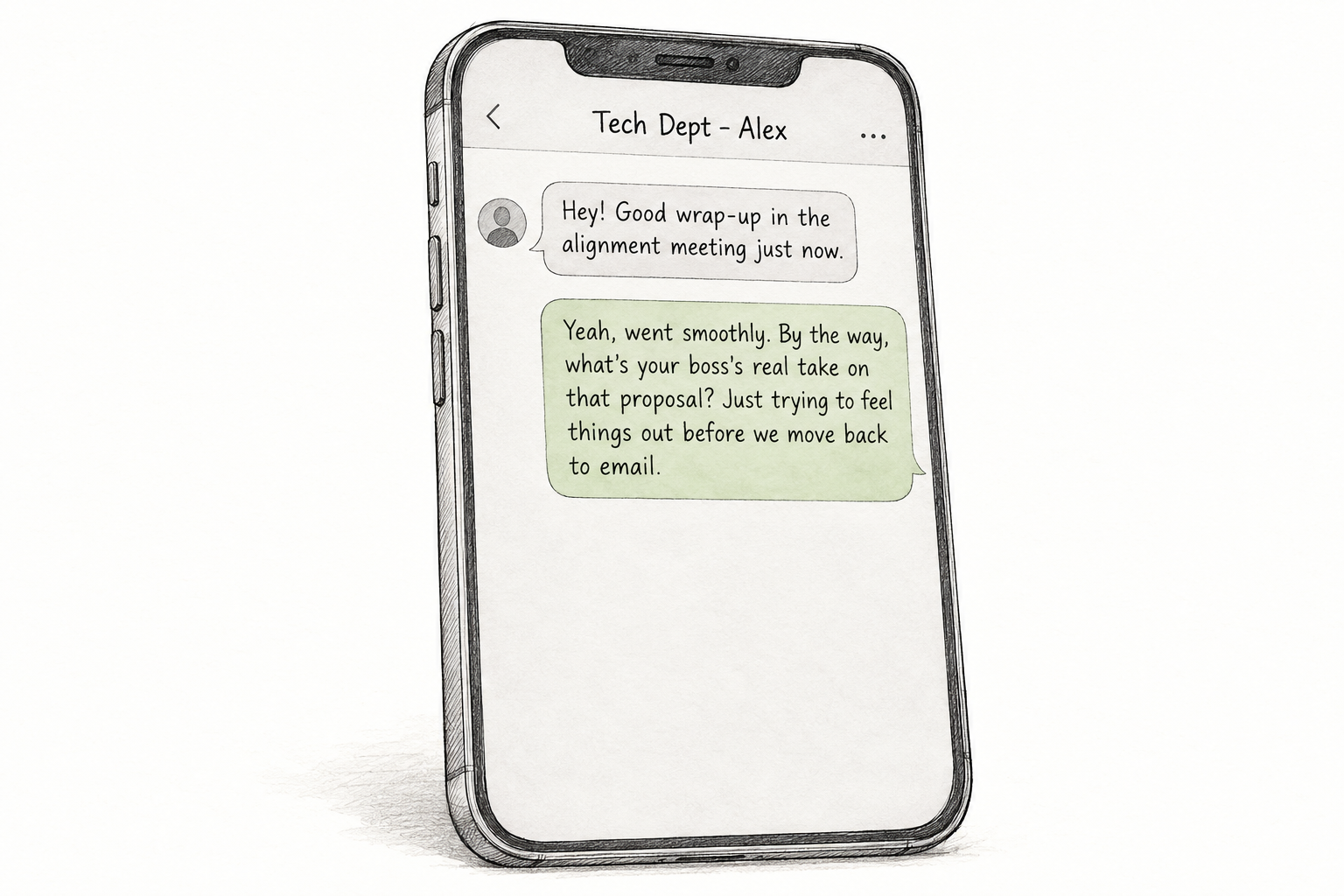
Anyone doing business in China will encounter WeChat sooner or later.
In many business settings, exchanging paper business cards has become less common. Connecting on WeChat, often followed by exchanging digital business cards or contact details, has become routine.
This is subtly different from how many international professionals treat WhatsApp. WhatsApp may also be used for informal business discussions, but exchanging WhatsApp details can still feel like moving a professional relationship onto a more personal channel. In China, adding someone on WeChat usually does not carry the same implication.
Exchanging WeChat contacts does not normally mean that someone has invited you into a purely private space. WeChat is already part of the business space.
A space where work and personal life overlap
This does not mean Chinese companies have stopped using email. Most companies working internationally have long adopted it as a standard form of business communication. Contracts, formal positions and important decisions still need a channel that carries company identity and leaves a clear record.
WeChat developed alongside it.
Part of the explanation is practical. The mobile phone is constantly at hand, and WeChat is already embedded in daily life. Short messages take seconds, and many conversations are conducted through voice messages, which can be faster and more natural for people accustomed to using them.
When an issue or project involves multiple parties, WeChat groups provide an easy way to exchange updates, comments, photographs and files as the work progresses. Business use is, in many ways, an extension of communication habits already established outside work.
WeChat can also be more practical than relying on telephone numbers. For various reasons, it is not unusual for someone in China to have more than one mobile number, while one WeChat account often remains the more consistent point of contact.
There is also a less obvious difference between a WeChat message and a phone call.
A call puts both people into the conversation immediately and can create unnecessary pressure when the matter is not urgent. A WeChat message gives the recipient more control over when and how to respond. Delayed replies are common enough that they do not necessarily require explanation.
WeChat also does not show read receipts in one-to-one conversations. The sender cannot see whether a message has been read and left unanswered. That small design feature leaves both sides some room.
A question can be raised without necessarily requiring an immediate answer. The recipient can respond later, answer only part of it, or leave a difficult point untouched. This also makes WeChat useful for testing a reaction or raising an issue before asking for a formal position.
Lower formality changes what can be asked, what can be said, and at what stage it can be said.
WeChat is therefore not simply a faster communication channel. It creates room for an issue to move before positions become formal.
The conversations too small for email
Most emails need a reason to exist. A WeChat message often does not.
A quick question. A photograph from the factory. A comment after a meeting. Congratulations on a new role. A response to something posted on Moments. None of these interactions is particularly important by itself.
Their cumulative effect can be.
Repeated, low-effort interactions create familiarity. A professional relationship can gradually become more personal without either side deliberately setting out to "build a relationship."
Moments is WeChat's social feed, where users can share photos, updates and other posts with their contacts. Moments adds another layer. Professional contacts gain occasional visibility into each other's interests and lives outside work. Discovering a shared interest, whether running, tennis, travel or something else, can create conversations that would probably never begin through formal business correspondence.
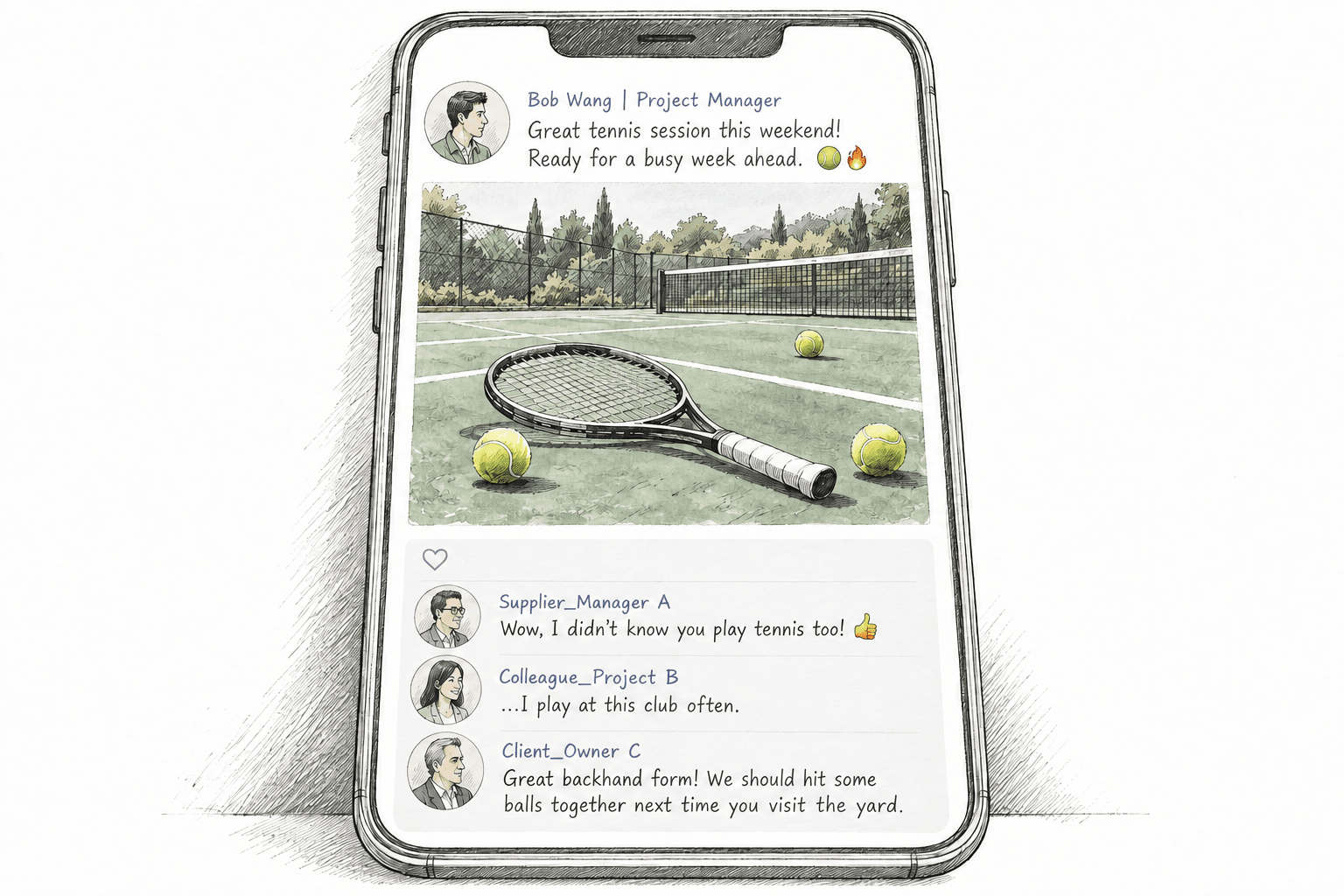
This is possible partly because WeChat does not maintain a hard separation between professional and personal identities. Work-related communication and glimpses of personal life exist in the same place.
That does not mean there are no boundaries, or that every contact welcomes messages at any hour. Nor does exchanging WeChat contacts automatically create a personal relationship or guanxi (relationships built through familiarity, trust and reciprocal ties).
It means that the boundary between professional communication and personal access is drawn differently, and the relationship does not have to remain confined to the reason the two people originally met.
Knowing when to move back
Lower formality should not be confused with lower accountability.
A WeChat conversation may feel informal, but messages, documents and voice messages can still be retained, forwarded or captured by the other party. Sensitive information, company interests and matters requiring confidentiality therefore deserve the same judgment as in any other communication channel.
An informal indication is also not a commitment, and an understanding between two people is not necessarily an agreement between two companies. Once an issue becomes contractual, commercial or otherwise consequential, what matters needs to return to the formal record.
A useful pattern can therefore be:
Explore informally. Understand the issue. Formalize what matters.
For international professionals working with Chinese companies, the point is not to replace email with WeChat, but to understand what the additional channel can do.
It creates space to test reactions before positions become formal, makes everyday communication easier, and allows familiarity and personal relationships to develop through interactions that might never happen through email.
Email records the position. WeChat can sometimes help you understand the position before it is written.
About Nuancia
Nuancia offers a closer view of Chinese companies across international energy projects and supply chains, Chinese business culture, and the practical realities of working with Chinese companies.
Nuancia is published for general information and commentary only. It does not constitute legal, financial, investment, engineering or other professional advice. Views and interpretations are those of the author unless otherwise stated. Full disclaimer