China Energy Watch
Nordex Knows How to Do Business in China
The German turbine maker has found considerable value in China's industrial capabilities. Its views on European market access tell another story.
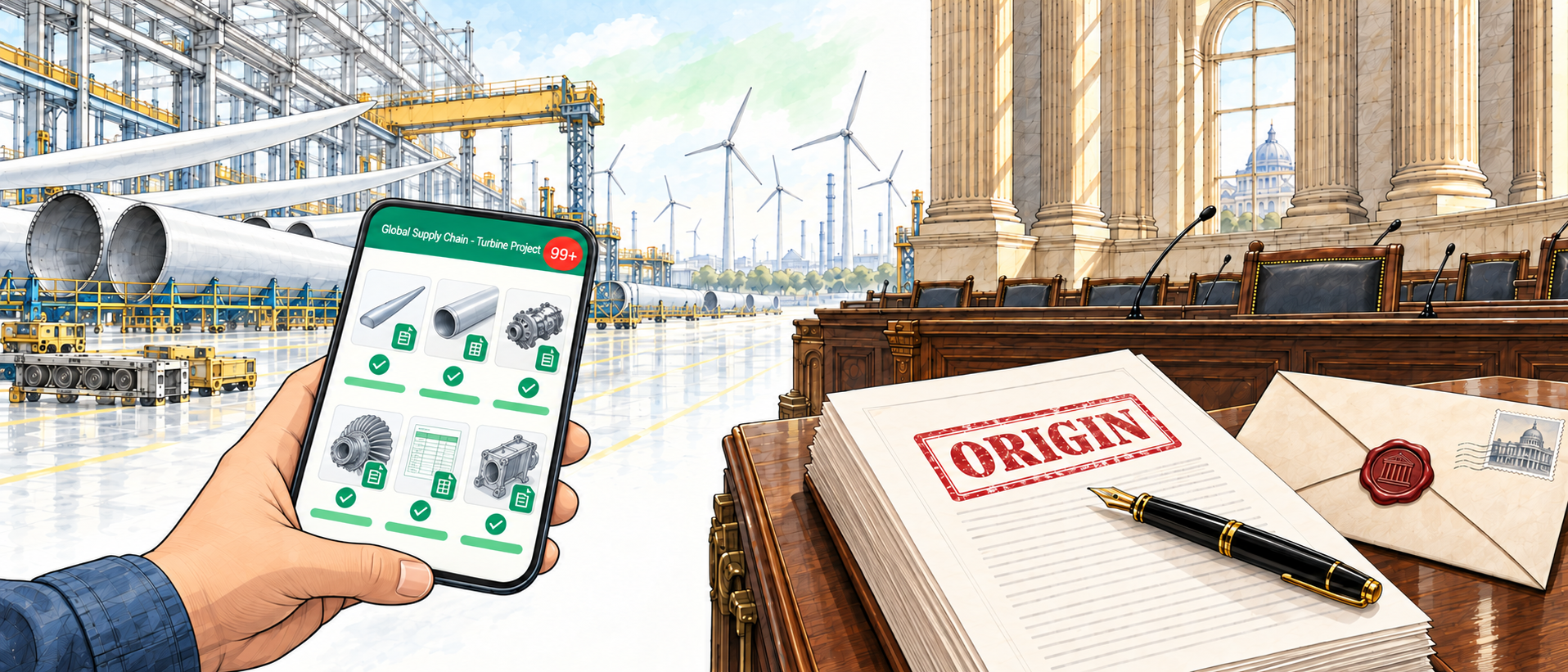
Nordex has opened an official WeChat account in China.
For European readers, this may seem like a routine communications decision. In China, WeChat is part of the business infrastructure. An official account helps a company reach suppliers, employees and potential partners, even when it has no domestic customers.
Nordex does not currently sell wind turbines in China's domestic market. Yet China has become an important part of how the German manufacturer produces and delivers turbines internationally.
The company's expanding Chinese operations tell one story. Its CEO's position on European market access has prompted another.
China's growing role
Nordex's relationship with China's supply chain is not new. Chinese suppliers accounted for 11.4% of its sourcing expenditure in 2019, when global procurement was coordinated principally from Germany and Spain, with regional sourcing operations including China. [Source: Nordex, Annual Report 2020]
The change is particularly visible in manufacturing. In 2025, Nordex produced 3,487 MW of turbines in China, up 53% from 2,278 MW in 2024. China accounted for 41% of Nordex's total turbine production in 2025. [Source: Nordex, Annual Integrated Report 2025]
The 2019 figure measures purchasing expenditure; the 2025 figure measures production capacity. They are not directly comparable. Together, they show a longstanding sourcing relationship and the scale China has reached within Nordex's manufacturing network.
Nordex also has local teams covering procurement, engineering, supplier qualification, manufacturing quality and logistics. These are familiar functions for international OEMs. The more interesting question is how they are used.
Beyond the immediate supplier
In April 2025, Jingye Yingkou Medium Plate agreed to supply steel plate for Nordex wind towers. The initial 20,000-tonne volume was later expanded to 40,000 tonnes. Jingye Yingkou had received Nordex's A-grade supplier certification in March, following discussions, factory visits and technical assessment. [Source: Jingye Yingkou Medium Plate, 2025 company disclosures]
The arrangement covered four partner tower factories in China and eight overseas. Initial export deliveries were for a wind project in Latvia.
Tower manufacturers typically procure steel plates and fabricate the towers, while turbine OEMs may also be involved in approving steel suppliers and material specifications. What makes the Jingye arrangement interesting is Nordex's involvement in coordinating steel supply across twelve tower factories in China and overseas.
Public disclosures do not establish whether Nordex buys the steel itself or sets terms under which its tower suppliers purchase it. That distinction matters commercially, but either structure gives the OEM a more direct role in upstream sourcing.
Other partnerships show a similar willingness to invest in qualification. Nordex began working with CRRC Yongji Electric in 2018. Factory audits, engineering reviews and prototype development preceded a 2021 agreement to supply generators for Nordex's Delta4000 platform. Yongji was already an experienced manufacturer. The work lay in qualifying its product for a particular international platform. [Source: CRRC Yongji Electric, company announcements, 2018–2021]
Chinese blade producer Times New Material offers an indication of scale. Its reported sales to Nordex rose from approximately RMB 40 million in 2023 to RMB 947 million in 2025, nearly 24 times the earlier figure. Times New Material was not new to international OEMs; the notable change was the volume of business. [Source: Times New Material, annual financial disclosures, 2023 and 2025]
These examples are not evidence of a uniquely Chinese procurement method. They show Nordex working systematically with established suppliers, connecting their capabilities to its engineering requirements and international production needs.
A model that travels
The international reach of this approach is visible in Argentina. In July 2025, China's export credit agency Sinosure disclosed its support for a 63 MW Nordex wind project for YPF Luz in Argentina. The exporter was Shanghai Nordex Wind Power, and Chinese content exceeded 60%. BNP Paribas and BNP Paribas Fortis provided financing backed by Sinosure's export buyer's credit insurance. [Source: Sinosure, 28 July 2025]
The transaction brought together Chinese manufacturing and export credit insurance, German turbine technology, French banking and an Argentine project owner. The 60% figure applies to this project, not to Nordex turbines generally.
It illustrates a capability that goes beyond finding competitively priced components: Nordex can combine manufacturing, technology and financing from different markets into a deliverable international project.
Why China matters to Nordex
Nordex's own explanation is unusually direct. In its 2025 annual report, the company says it has “shifted its focus to China to capitalize on cost advantages” and refers to cooperation with partners experienced in supplying Chinese turbine OEMs. Its stated aims are greater efficiency, higher volumes and significant cost savings. [Source: Nordex, Annual Integrated Report 2025, production network and supply-chain discussion]
Nordex's financial performance has improved during the same period. Its EBITDA margin rose from approximately break-even in 2023 to 4.1% in 2024 and 8.4% in 2025. In October 2026, the company raised its full-year guidance to 11.5–12.5%. [Sources: Nordex, Annual Integrated Reports 2024 and 2025; Nordex, October 2026 financial guidance]
Improved project execution, commercial terms, business mix and service activities all matter. Public disclosures do not isolate the contribution of Chinese sourcing to the margin improvement. The parallel development is nevertheless worth observing.
Nordex has also emphasized maintaining manufacturing options across China, India and Europe. The point is not to replace one region with another, but to retain flexibility as costs, trade measures and customer requirements change.
What does Western origin mean?
Nordex's growing involvement in China has attracted attention following remarks by CEO José Luis Blanco about European market access.
In a May 2026 interview with the Financial Times, Blanco argued that “the western-origin principle should therefore apply to all new wind capacity connecting to European grids, not only publicly supported projects.” His concerns included technology independence and control over turbine software and system access. [Source: Financial Times, May 2026, interview with José Luis Blanco]
His position sits within a wider European debate about industrial competitiveness, supply-chain security and market access. Some Chinese industry commentators have questioned the contrast between Nordex's extensive use of Chinese manufacturing and its CEO's proposed principle.
The harder question is what should actually count as Western origin.
Is it the nationality of the OEM, the origin of the components, ownership of the technology, or control of the software and operating systems?
Buying Chinese components is not the same as selling a Chinese-designed turbine. Nordex can integrate Chinese-manufactured parts while retaining responsibility for design, certification, software and warranties. If Western origin primarily concerns technology ownership and operational control, its manufacturing model may be consistent with the principle. If the test also requires supply-chain independence, the answer becomes less straightforward.
The positions are not necessarily contradictory. They can nevertheless look different from opposite sides of the supply chain.
Nordex's arrival on WeChat might have passed almost unnoticed in Europe. In China, it has prompted a rather different conversation.
For Chinese suppliers, Nordex is an important international customer that knows how to leverage China's manufacturing capabilities to its own advantage. For some observers in the broader Chinese wind industry, it is also a European competitor whose CEO advocates restricting the entry of turbines that do not meet his proposed Western-origin principle.
There is nothing unusual about a company seeking competitive suppliers while defending its market position. What makes this case striking is how successfully Nordex appears to have combined the two.
The WeChat account is a small detail. The much bigger story is how deeply a European turbine manufacturer has learned to operate within China's industrial ecosystem, and how differently that relationship is understood on either side.
About Nuancia
Nuancia offers a closer view of Chinese companies across international energy projects and supply chains, Chinese business culture, and the practical realities of working with Chinese companies.
Nuancia is published for general information and commentary only. It does not constitute legal, financial, investment, engineering or other professional advice. Views and interpretations are those of the author unless otherwise stated. Full disclaimer