China Energy Watch
Chinese Wind Companies Are Changing Shape as They Go Overseas
Recent moves by Dajin Heavy Industry and Ming Yang Smart Energy show Chinese wind companies taking very different approaches to Europe. Together, they offer an early view of how expanding overseas may reshape not only where these companies operate, but how they build and deliver their businesses.
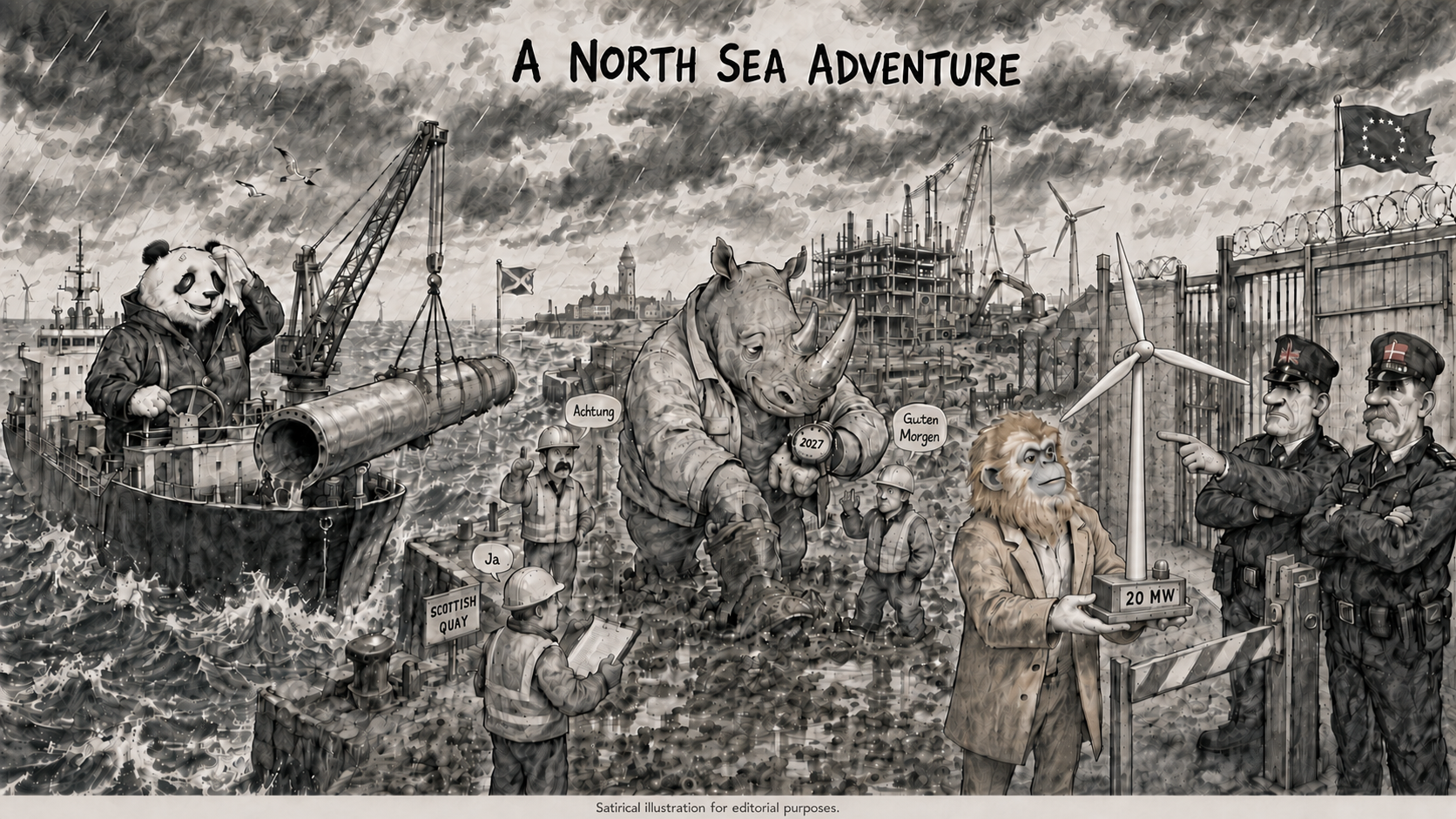
In August, Dajin and Haventus signed an MoU to explore the use of Ardersier Energy Transition Facility in Scotland for offshore wind foundation marshalling, assembly and related activities.
Ming Yang has continued to build its European organization and engineering capabilities while pursuing plans for local manufacturing.
Titan Wind Energy, meanwhile, is developing a major monopile manufacturing operation in Cuxhaven, Germany.
Taken individually, these are different developments. Seen together, they point to something broader.
Chinese manufacturers are beginning to make different choices about what should remain in China, what needs to sit closer to customers, and how those capabilities should work together.
Internationalization can change the company at home
Dajin is an interesting example because much of its international expansion is still being built from China.
Overseas revenue has risen from 39.6% of total revenue in 2023 to 74.5% in 2025. At the same time, rather than shifting its manufacturing base wholesale to Europe, the company has continued to invest heavily in specialized capacity at home.
Its new Caofeidian facility in Tangshan entered production in late 2025. Together with its established Penglai facility, it gives Dajin a substantial China-based manufacturing platform for serving international offshore wind projects.
Dajin is also extending its role beyond fabrication. It has moved into DAP delivery on European projects and invested in purpose-built transport vessels. King One has already completed its first European delivery and embarked on a second, while King Two has now begun its maiden voyage carrying monopiles for the BC-Wind project.
But how much of its planned European footprint will ultimately materialize remains to be seen.
Ardersier is not Dajin's first European port MoU. An MoU signals an area the parties intend to explore; it does not tell us what investment or capabilities will eventually follow. The MoU is therefore better read as an indication of direction than evidence of an operating footprint.
For now, Dajin is testing how far an international delivery model can extend from a manufacturing base that remains largely in China, and which capabilities, if any, ultimately need to sit closer to European projects.
There is more than one route
Titan illustrates a different approach.
Titan acquired the former Ambau facility in Cuxhaven in 2019 and is now developing a major European monopile manufacturing operation there. The project has taken considerably longer to develop than originally anticipated, with production currently targeted in 2027.
Titan brings manufacturing experience from China, but Cuxhaven will still have something to prove. Experience at home does not automatically translate into a European offshore monopile track record, particularly when the factory, workforce and supply chain are new.
This highlights something easily overlooked when overseas manufacturing is announced:
A factory abroad does not automatically reproduce the advantages of a factory in China.
The company still has to build or access a local supply chain, recruit and manage a local workforce, qualify production and secure enough orders to make the operation competitive.
For Chinese manufacturers accustomed to operating within China's dense industrial ecosystems, that can be a very different challenge from exporting.
The more useful question is which capabilities genuinely benefit from being local, and which remain more competitive when connected to China.
Turbines are different
Foundation manufacturers have considerable flexibility over where different parts of the value chain sit. For turbine manufacturers such as Ming Yang, the relationship with the project continues long after the equipment is delivered.
That makes the question of what needs to become local more complicated.
Ming Yang is not entering Europe on manufacturing cost alone. It is also bringing larger turbine platforms developed in China, while its European engineering team is adapting products to European grid codes, operating conditions and customer requirements.
Building a sustainable European turbine business may therefore require a deeper local presence than manufacturing alone.
Huawei offers an interesting precedent from another industry. Its international expansion eventually extended far beyond sales into local employees, R&D, service capabilities and deep customer relationships. Yet it also showed that localization alone does not necessarily resolve questions of trust and control when technology becomes part of critical infrastructure.
That distinction is already visible in wind. Ming Yang has been building European engineering capability and addressing issues such as certification and data residency, while continuing to encounter political resistance in markets including the UK and, more recently, Denmark.
In some parts of critical infrastructure, there may be no level of localization that fully removes the question of where the company ultimately comes from.
For Chinese turbine manufacturers, the strategic question may therefore be not simply how much to localize, but where localization can genuinely change the equation.
Different routes are beginning to emerge
What happens next will be more revealing than the announcements themselves: whether Dajin turns European MoUs into operating capabilities, whether Titan can translate its manufacturing experience into a competitive European operation, and how far localization can genuinely change the equation for Ming Yang, and where it cannot.
These are different routes to the same broader question:
What does a Chinese wind company actually need to become in order to compete sustainably outside China?
The answer is unlikely to be the same for every company, or every part of the wind supply chain.
About Nuancia
Nuancia offers a closer view of Chinese companies across international energy projects and supply chains, Chinese business culture, and the practical realities of working with Chinese companies.
Nuancia is published for general information and commentary only. It does not constitute legal, financial, investment, engineering or other professional advice. Views and interpretations are those of the author unless otherwise stated. Full disclaimer